
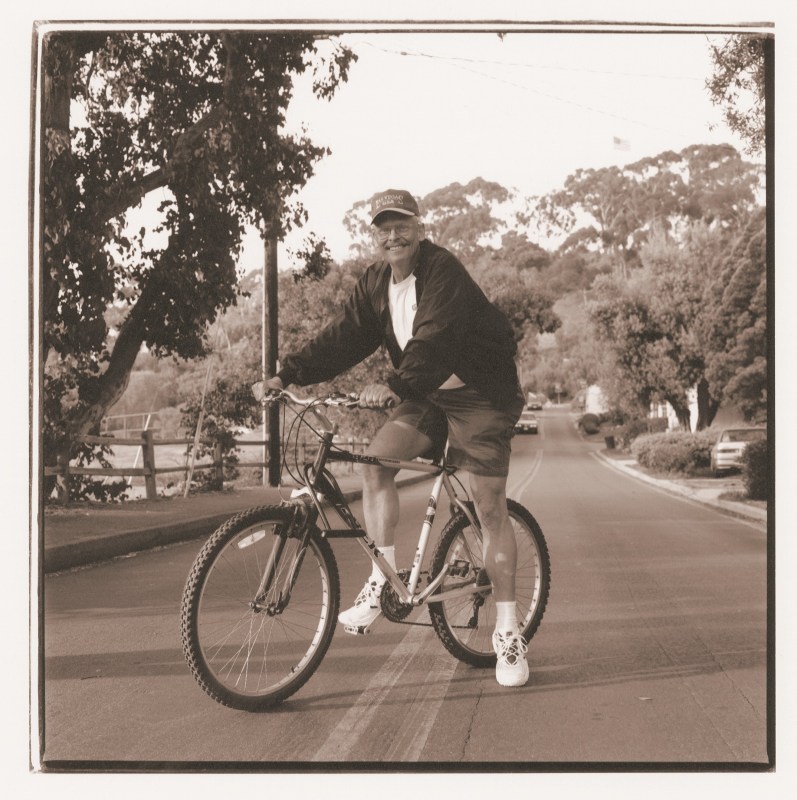
Excerpt from Open Doors: Vietnam POWs Fifty Years of Freedom
“I always like the POW reunions ‘cause I’m the youngest. At work, I’m the old guy, so I guess it’s all relative.” Unlike most of his POW colleagues, he wasn’t shot down from a jet or captured in the jungles of Vietnam. He was plucked out of the Gulf of Tonkin after falling overboard from his ship where he was a very young and newly minted sailor.
Doug was born near Watertown, South Dakota. His parents were of Scandinavian descent, but they refused to teach the kids Norwegian, insisting Doug and his two brothers become as American as possible. Scandinavians are sturdy stock: his parents worked around the clock to make ends meet at a hotel they owned near the highway in their town.
When Doug was nineteen, he received a draft notice from the Army. “I wanted to see the world. I figured there’d be a better chance in the Navy.” So, he enlisted and headed to boot camp, where his mom wrote him every day. He went to sea on the USS Canberra. While on station in the Gulf of Tonkin, Doug was blown overboard. Thinking he was dead, his ship held a memorial service for him, but his mother was convinced he was alive. “Everybody thought she was a little crazy. She was mending a pair of my pants and she set them on her mending stool and she didn’t touch them until I came home. Then she said, ‘Now you can move them.’”
While his Vietnamese captors were scratching their heads, trying to figure out if his story was true, his fellow prisoners noticed his unusually sharp memory. Dick Stratton said, “When I first met him, he asked me if I knew the Gettysburg Address and we got a rock and wrote it on the floor and he could say it backwards. Now, why you’d want to say it backwards, I don’t know, but he could.”
Doug reminisces, “I’d always memorized lists of presidents and state capitals—which is kinda trivia. So, why not take that ability and harness it for something practical like memorizing names or camp locations. Eventually, I memorized 250.
“I found that turning the names into a ditty helped. So…Lieutenant Colonels Crow, Jim Hughes, James Lamar, Gordon Larson, Robbie Risner, Hervey Stockman, Majors Elmo Baker, Al Brunstrom, Jack Bomar, Dick Bolstad, Don Burns, Ron Byrne, Art Burer, Fred Cherry, Will Cordier, Larry Guarino, James Hiteshaw, Ken Hughey, Sam Johnson, Sam Makowski, Ray Merritt, Al Runyan.” He sounds a bit like an auctioneer, running the words together as he effortlessly spits them out in a single breath. He exhales. “It’s always easier to memorize a poem than it is a bunch of meaningless words.”
“Even then, I think Commander Stratton thought if they released somebody, they would release me.” The senior prisoner in their camp requested he take an early release, for they knew his knowledge would be valuable information. As hard as it was for him to leave behind others who had been held longer, he had been given an order and a mission. For those 250 names he memorized gave peace of mind to 250 families; they knew their loved one was indeed alive.
Except for his gray hair and few wrinkles around his small, beady eyes, Doug has retained his boyish looks, shy and humble demeanor and flat, dry sense of humor. He recently retired after close to thirty years as an instructor at the Navy’s POW survival and training school, the first position he took upon returning from Vietnam. A fitting job for a former POW, the responsibility allowed him to pass on the lessons he learned. “When I retired, they gave me a big shadow box. I got the civilian commendation award. I guess it is one of the highest ones.” He shrugs.
He never married nor had children. He had a girlfriend for sixteen years, but she died in 1995. He doesn’t like to talk about her. He lives by himself in a modest house he owns in Ocean Beach, California, and rides his bike up to six hours every day. “I’m a loner most of the time.” He doesn’t seem to understand the continued interest in his POW experience.
What’s left for him to do? He shrugs. “Well, I was thinking about getting one of those bicycle taxis, you know. Pedal people around and make money.…I’d also like to visit Australia. I missed that part of the sea tour on the USS Canberra when I fell overboard.”
Open Doors: Vietnam POWs Fifty Years of Freedom takes a close look at thirty former Vietnam POWs from all branches of the military. Produced by photographer Jamie Howren and author Taylor Baldwin Kiland, the exhibit was created in 2003 on the 30th anniversary of the men’s return and updated for the 50th Anniversary in 2023. The exhibit includes 31 impressionistic photos and accompanying written profiles intended to capture these extraordinary American men who were tested like few people of subsequent generations have. It is also intended to defy the lingering negative stereotype of Vietnam veterans.
Open Doors is available for rent as a traveling exhibit to museums, libraries, universities, and other cultural institutions. For more information, please contact info@coronadohistory.org.

